Between the Eye and the Soil
Algorithmic Colonialism, Memory, and the Art of Refusal
Overview
This research was developed during my residency in Italy at Fondazione Pistoletto, where questions of technology, ethics, and responsibility intersect with artistic practice. It examines how contemporary systems of algorithmic surveillance operate as a continuation of colonial logics—reconfiguring land, bodies, and memory into datasets to be monitored, predicted, and controlled.
Grounded in the lived reality of Hebron, the research departs from the city as a laboratory of imposed technologies: cameras, databases, biometric systems, and predictive infrastructures that fragment space and reduce human presence to measurable risk. Here, the algorithm does not merely observe—it governs, redraws boundaries, and produces new forms of erasure.
Rather than approaching technology as an abstract system, this research treats it as a material force that reshapes how memory is stored, how space is experienced, and how the body learns to move, hesitate, or disappear.
Context and Research Framework
Hebron is one of the most intensely surveilled cities in the world. Layers of military, civilian, and algorithmic control overlap in its streets, producing a geography where vision itself becomes a tool of domination. Cameras do not simply record; they classify. Databases do not simply store; they decide.
Within this context, the research draws on the notion of algorithmic colonialism—where digital systems inherit and extend older colonial practices of mapping, categorization, and control. What was once enforced through paper archives and physical checkpoints is now enacted through code, data extraction, and automated judgment.
The residency at Fondazione Pistoletto provided a space to situate this local condition within a broader global discourse on technology, ethics, and social responsibility, allowing the research to move between Hebron and Europe without flattening their differences.
Memory Under Algorithmic Regimes
A central concern of this research is how memory behaves under constant surveillance. When every movement is recorded, memory no longer belongs to the body or the community—it is externalized, indexed, and owned by systems designed to outlast human presence.
This produces a double fracture:
the erosion of lived, embodied memory
and the emergence of an imposed, machinic archive that speaks about people without speaking with them
In such conditions, forgetting becomes both enforced and strategic. Certain histories are erased, while others are endlessly replayed through data. Memory turns from a living process into a controlled asset.
Artistic Methodology
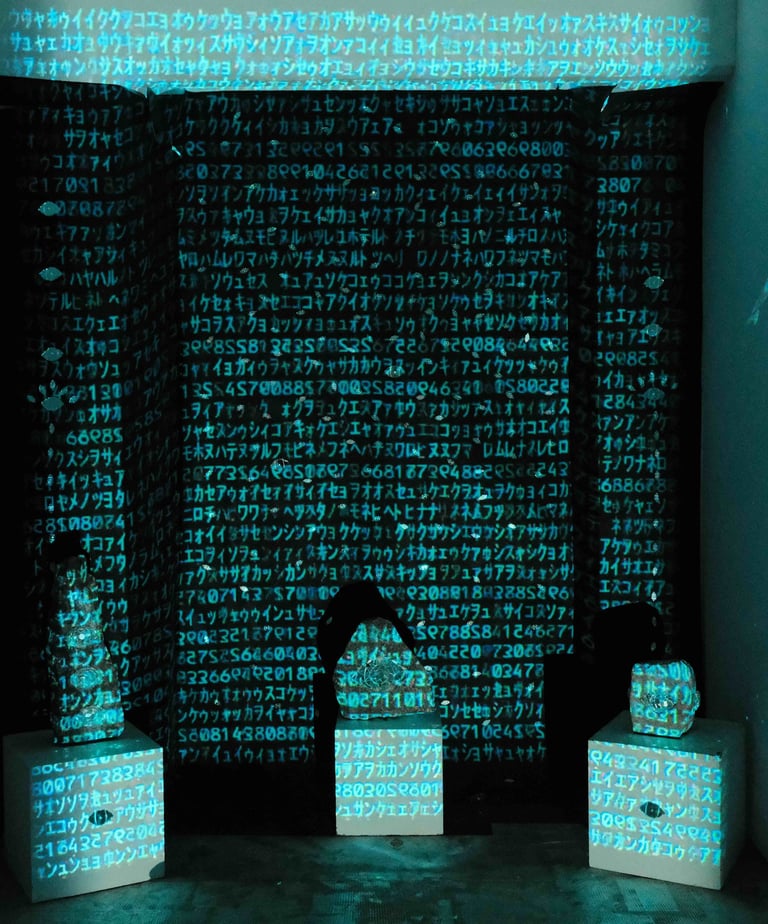
The research unfolds through writing, mapping, and the development of an installation-based artistic work. Rather than visualizing surveillance directly, the work focuses on its residues: fragmentation, repetition, absence, and the tension between visibility and refusal.
Materials such as stone, thread, maps, and reflective surfaces are employed to counter the immateriality of algorithms, insisting on weight, friction, and presence. The artistic process operates as a form of excavation—reading systems of control not through their interfaces, but through their impact on land, bodies, and perception.
The work does not seek to expose or represent surveillance, but to interrupt its logic by slowing it down, displacing it, and returning attention to what resists measurement.
Refusal as Practice
At the core of this research is the idea of refusal—not as withdrawal, but as an active position. Refusal here means rejecting legibility on imposed terms, refusing to become fully readable to systems that reduce life to risk profiles and patterns.
Art becomes a space where opacity is preserved, where meaning cannot be fully extracted, and where memory is allowed to remain partial, fractured, and alive. This stance challenges the expectation that everything must be documented, optimized, or translated into data.
An Ongoing Research
This research remains open and unresolved. It continues to evolve through artistic production, writing, and dialogue across contexts. Its outcomes may take the form of installations, essays, or public conversations—but its core commitment remains the same: to question how technology reshapes memory and to insist on practices that protect what cannot, and should not, be fully seen.